A Life Project by Vicente "Tex" Hernandez



Pandora’s Endless Want
Curiosity led Pandora to open her jar. Did we follow her lead? What are we seeking from life—surely something special, mostly happiness? Against all warnings, Pandora lifted the lid, expecting a blessing from the gods. Behind her curiosity is the desire for something better. Instead, sickness, death, suffering, greed, and envy escaped and spread across the world.
MEANING
TH
6/4/20264 min read
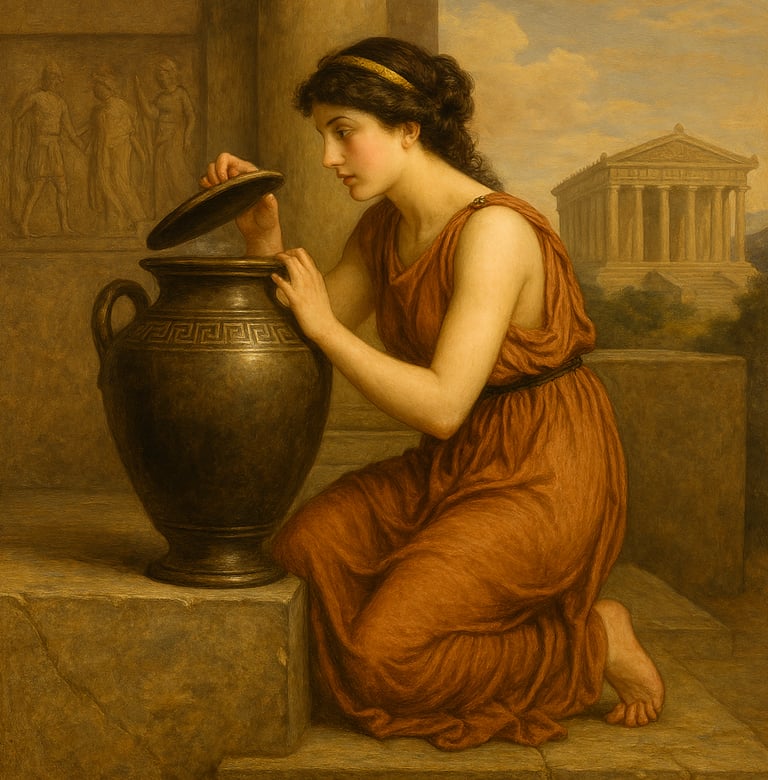

We always reach into Pandora’s jar hoping to find something good to make us happier, but whatever we draw soon turns sour. Isn’t that the story of our lives? We tend to reach out to whatever seems more convenient or attractive, often giving little thought to the consequences.
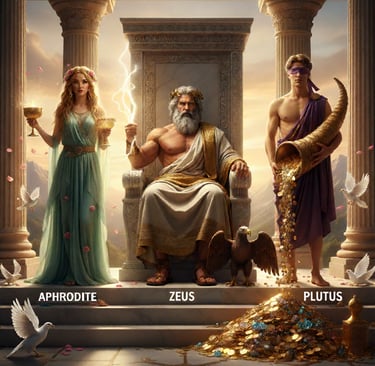
In ancient times, the gods shaped the ambitions of the human heart: power, wealth, and pleasure. Each distant deity, dwelling in their endless firmaments of divinity, contributed in one way or another to fill the vacuum that, apparently, every empty human heart harbors. And so it is today. Do we still desire power, wealth, and pleasure above all else?
The challenge is that we never have enough of power, wealth, and pleasure—and if we manage to keep them, their sheer weight becomes unbearable. Like everything we accumulate in excess—check what you keep; are you a hoarder?—sooner or later, it turns against us and crushes us. Moreover, because we never find peace in what we have, we don’t find satisfaction—only distress.

You see, there’s always something that looks better, feels better. What’s better than a Fiat? A Ferrari. And what’s better than a Ferrari? Two Ferraris: one for weekdays, the other for weekends. In our country, a government official was found to own 40 luxury cars. Weren’t two Ferraris enough?
Is it bad to have a Ferrari? Not really—unless possessing it turns into an obsession that blinds you to what truly matters. Human ambition—along with power, wealth, and pleasure—isn’t the enemy, but it can be distracting and empty. At some point, the thrill fades. This is when you realize that owning a fast car doesn’t automatically point you in the right direction. That’s when the search for something more stable—like a personal compass—starts. We might not have a dozen clear paths laid out, but we do have one solid starting point: the need to find meaning.
We talk a lot about meaning—but what does it actually do for us? Well, for starters, it gives us direction. A kind of Polaris, if you will. But direction to what, exactly?
Ultimately, we all want a life—not just one that looks good on paper, but one that feels right. What that life means for each of us is personal. Maybe you already know what you want. You might even have a plan. But are your plans truly aligned? Are you managing your life toward what actually matters?


So, how do we make sure we’re not just winging it? State your priorities. Stage your plans. Start right. Choose meaningfully. Force yourself to reflect on what’s truly important—the values we live by, not just the goals we chase.
Of course, old habits die hard. Power, wealth, and pleasure still tend to take center stage when we think about success. But here’s the good news: we’re not stuck with that default. We can shift the focus and realign those goals with what actually matters. Why not approach it differently?
I want wealth—not just for myself, but for my family, my friends, my business partners, and the people who rely on me. Same with power: in my position, I aim to improve services, enhance the environment, exert a positive influence, and make a meaningful difference. And pleasure? Real pleasure isn’t just about indulgence—it’s found in love, in mastering a craft, in building peace, and in creating a space where your people can thrive.
Let’s take it one step further. Meaning gives us direction—but what’s the fuel behind it? We all chase a kind of elusive happiness—in our plans, our goals, even in the meaning we try to pin down. But is there something even more important than all that?
Let me tip you off: for some, it’s something essential and hard to find; for others, it’s something they underestimate but already possess. There’s no greater purpose—or deeper satisfaction—than doing what we do for love.


The need to love and be loved is forged into our nature, giving meaning to everything we do. But love is only truly satisfying when it reaches beyond the self—because to love and be loved, two are needed. A selfish love is incomplete: it centers on one, not two; love is only love to the extent that it concerns another.
We truly love someone for who they are, not for the benefit we gain from them. And so, we come to a deeper understanding of love’s true nature when it’s expressed even toward someone who is physically or mentally ill, and indifferent to us. Genuine love moves us to care without expecting anything in return.
This kind of love can be meaningful even in the simplicity of doing good for others—in a project for the welfare of people, in a religious commitment, or in the care of a family business that requires a career shift. Because in the good of others, we always find a form of reciprocity. Selfish reciprocity is fleeting; but any act done for the sake of others carries lasting meaning.
In the end, meaning, values, and purpose all point toward one thing: love—not as sentiment, but as motivation. It’s what transforms our goals, reframes our ambitions, and gives depth to our lives. Whether through service, sacrifice, or simple kindness, love is the thread that holds it all together. Without it, even the best plans fall flat. With it, even the smallest gesture becomes profound. We cannot live without love.
Contact & Inquiries
info@echoepolaris.com
© 2025. All rights reserved.


If you have any feedback, comments, or questions, feel free to share your email address.